Radio remains a familiar way to deliver local audio, even as listening habits shift toward streaming. Nielsen’s 2024 Audio Today report estimated that AM/FM radio reached about 91% of U.S. adults in an average week. Edison Research and Triton Digital’s 2024 Infinite Dial report also found that 70% of Americans aged 12 and older listened to online audio weekly. These figures describe different listening channels, but they show why radio technology still matters.
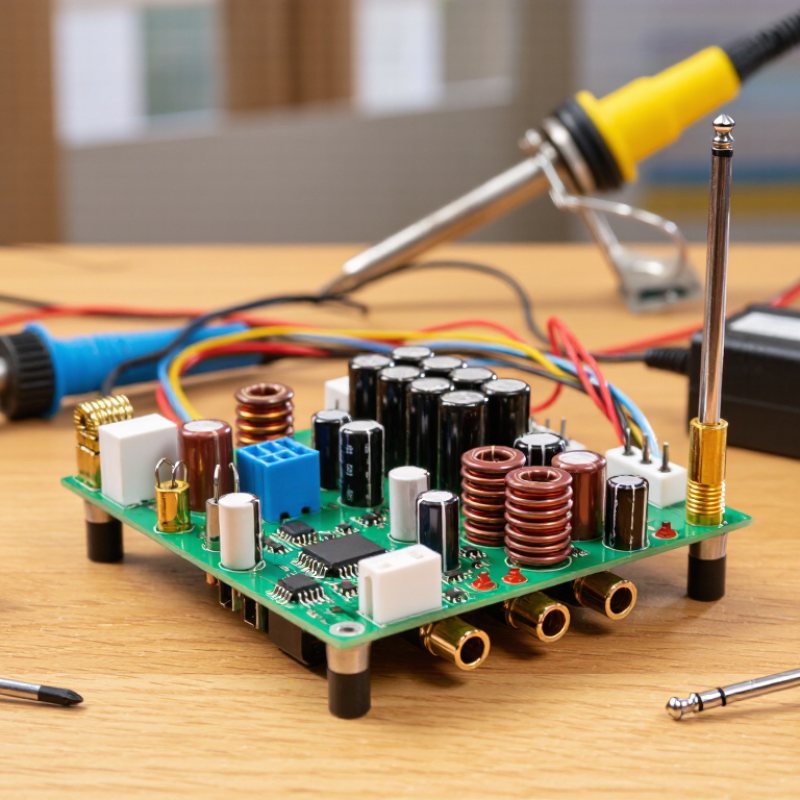
A Fm Radio Transmitter Kit is a compact electronics set designed to send an audio signal over FM radio waves. Typical parts include a circuit board, an audio input, a power connection, and an antenna connection. Some kits add a case or basic assembly instructions. At a workbench, a user might connect a small audio source, check the wiring, and listen for the signal on a nearby receiver. Simple in appearance. Yet the result depends on careful assembly and testing.
A kit is not a complete broadcast station. That distinction matters. Sound quality and signal stability can vary with component quality, power supply noise, antenna placement, and the surrounding environment. Product specifications should explain these limits clearly. Practical use should also follow applicable technical requirements and take place in an authorized setting. One detail deserves reflection: a neat circuit diagram cannot guarantee a clean result. Understanding the signal path—and documenting what changes during testing—helps users evaluate the kit with greater care.
An FM radio transmitter kit is a compact set of electronic parts. It converts sound from a phone, microphone, or small mixer into a radio-frequency signal. A nearby FM receiver can then play that signal through its speaker. Typical parts include an audio input, modulator or oscillator, power supply, and antenna.
Not quite magic. Range and sound quality depend on antenna placement, interference, and circuit design. On a desk, a short wire antenna may work differently beside a wall or window. That practical variation is easy to underestimate.
The purpose is to connect audio equipment to FM receivers without a direct cable. Small venues, classrooms, and hobby demonstrations may use kits for controlled, nearby audio distribution.
Ofcom’s Media Nations 2024 report estimates weekly radio reach at about 87% among UK adults. That helps explain why FM receivers remain familiar.
A kit does not create a broadcast service by itself. Frequency stability, output strength, and local rules still matter. Use only equipment and settings permitted in your region. Kit specifications can be incomplete, so treat claimed range as an estimate, not a promise.